
A few years ago, after having a breakdown in a not public but not entirely private setting during a very low point in my life and ministry, a friend texted me something I desperately needed/still need to hear:
“You are enough!”
I have never believed that, certainly never as an adult and very certainly never as a professional minister. I used to lie and say things like “On the good days…” or “When I’m not struggling…” to say that sometimes I have confidence in my wholeness and “enough-ness,” but I truly have never, not for a single moment, believed I am enough.
If you ask me, and I am honest with you, I will tell you I am not enough for anyone or anything, certainly not for ministry and certainly not for God.
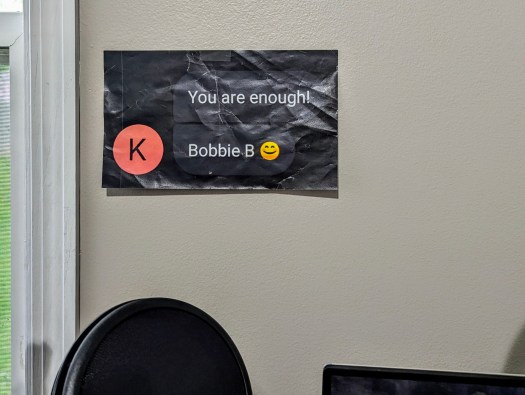
I printed a screenshot of that text to tape to my office wall to remind me that I am enough. I never believed it — not for one second — even with the reminder, but someone I trusted believing it might make it a true statement.
I know I have written about that printed screenshot before, but it came back around recently. During my (vain) attempt to clear my desk and make my home office functional, I happened upon the printed reminder that someone else believes I am enough. I looked at it, crinkled and creased from multiple moves, and I decided to put it up again to try to maybe make it true in my mind — or at least quiet the lies my brain tells me and make them less authoritative in my life.
Here’s the thing: I am probably never going to believe that, not for real. My brain lies to me, and it will continue to lie to me. Because my brain is me, and my brain tells me I am not enough, I tell me I am not enough, and I believe me and not external things. And I assume, because you read something I wrote, your brain probably lies to you, too; I assume well-adjusted peeps do not read what I write on this here blog.
This could easily become a few hundred words of me beating myself up, and everyone who knows me probably assumes I will land there eventually, but I have spent much of the past few years trying to give myself grace. Maybe I will never believe in myself or my “enough-ness,” but that lie did not come from nowhere. I did not just wake up at age six, or age thirteen, or age thirty-seven and randomly decide I am not enough. Even now, ordained and practically competent at pastoring and interim ministry, I hear external voices that tell me I am not good enough, that I should just be silent and never speak (unless I agree with the voice) because of my identity, because of my heritage, because of the way I think, because of whatever reason. I still have my struggles minimized, have my wisdom denied, have my skills cast aside.
I did not just start lying to myself. External voices taught my internal self the lies, and now my internal self cannot help but constantly repeat them. Again, the internal voice is me, so I repeat them deep inside myself, over and over again. I did not do this to myself, and I am responsible for trying to do better but that voice inside me may never actually get better.
What can I do to show myself grace and function, then? I wonder if we can start believing it for each other. I have a print on my wall that tells me a friend believed it when I hit what I thought was my lowest point (COVID brought me lower), I have other friends who tell me I am enough, I hear it enough that I can act and minister like I am enough, even if I never believe it.
Maybe, if we expressly believe it for each other, maybe if we can tell each other over and over that we are enough, maybe believing it for someone who cannot believe it for themselves can be enough, at least for the moment. It would be better if external voices stopped telling us we are not enough — and that the one external lie would be drowned out by the multiple external truths — but since that day will never come, maybe if we believe for each other and say it to each other, we can act like we are enough.
Maybe we can.
Caveat: This only works when you tell someone directly that you believe they, specifically, are enough. Vague, generic, non-specific, universal social media “Just remember you are enough!” posts do nothing. I do not care that your theology makes you believe everyone is enough; mine does, too, and it has done nothing to help me. This is a call to tell a person (or persons) they specifically are enough, that God uses them specifically, and maybe some evidence to that fact.
No more platitudes and performative social media. They only help the poster.
Peace,
– Robby
P.S.: Here is the photo in its new home:

 Red Shoe Pastor
Leave a comment